
Honeycomb Curtain Cleaning & Maintenance Guide: Can You Wash It? Correct Vacuum & Spot-Clean Methods + Damaged Fabric Failure Cases
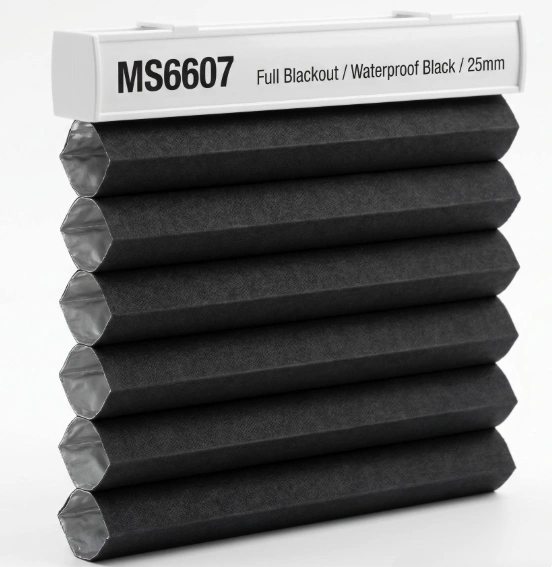
Custom 25mm Black Full Semi Blackout Spunlace Non-woven…
For buyers, designers & sourcing teams
CategoryUncategorized
Use this article as a technical reference. Contact us if you need fabric samples, specifications or project support.
Honeycomb cellular curtains are favored by modern families for their excellent insulation, noise reduction, and blackout performance. However, their unique three-dimensional hollow honeycomb structure and bonded craftsmanship make their maintenance completely different from ordinary flat fabric curtains. Most fabric damage, structural collapse, and shortened service life of honeycomb shades are not caused by quality problems, but by incorrect daily cleaning methods.
The most frequently asked question by users is: Can honeycomb curtain fabrics be washed with water? Many homeowners arbitrarily soak, rinse, or machine-wash honeycomb curtains, resulting in irreversible scrapping of high-priced window treatments. Meanwhile, improper vacuuming and wrong stain removal methods will also cause fabric fuzzing, color fading, and honeycomb degumming.
This professional maintenance blog will clarify the water washing controversy of honeycomb fabrics, share standardized vacuum dust removal and local stain removal operation guidelines, analyze typical failure cases caused by wrong cleaning, and provide long-term maintenance tips to help users effectively extend the service life of honeycomb curtains and avoid maintenance losses.
1. Core Question: Can Honeycomb Fabrics Be Washed with Water?
The unified professional answer for most household conventional honeycomb curtains is: No soaking, no full water washing, no machine washing. Only individual manufacturer-specific washable models support partial water cleaning, while the vast majority of recycled polyester and conventional polyester honeycomb fabrics are not resistant to long-term water immersion and flushing.
Different from integrated woven ordinary curtains, honeycomb curtains are formed by physical high-temperature pressing and environmental adhesive bonding. The three-dimensional honeycomb cavity structure relies on bonding points to maintain stereoscopic shaping. Long-term water soaking, high-pressure water flushing, and machine washing will directly dissolve and loosen the bonding glue inside the honeycomb, causing the core structure to collapse.
Key hazards of wrong water washing
- Degumming and cavity collapse: The adhesive fails after water soaking, the independent honeycomb cavities flatten and cannot rebound, completely losing insulation and stereoscopic decoration effect.
- Fabric wrinkling and deformation: The hollow fabric shrinks unevenly after absorbing water, resulting in overall wavy distortion, unable to fit the window frame normally.
- Mold and peculiar smell: Water accumulates in the closed honeycomb cavity and cannot be completely dried, breeding mold and bacteria, causing persistent odor and mildew spots.
- Coating peeling and fading: The blackout functional coating on the fabric surface falls off after water washing, leading to reduced shading rate and uneven color.
Special Note: For a small number of fully washable honeycomb curtains marked on the official label, only low-temperature water floating washing is allowed, and soaking and scrubbing are still prohibited. Ordinary household products are uniformly defined as non-washable integral structural fabrics.
2. Correct Daily Cleaning Operation: Standard Vacuum Dust Removal
Most of the daily dirt on honeycomb curtains is floating dust and suspended particles. Vacuum cleaning is the safest and most efficient daily maintenance method, which can avoid water damage and keep the fabric fresh for a long time. Standardized operation is required to prevent secondary damage caused by incorrect vacuuming methods.
2.1 Pre-Cleaning Preparation
Adjust the curtain to a fully closed flat state to ensure the honeycomb cavities are fully unfolded and the fabric surface is smooth. Prepare a handheld vacuum cleaner or household vacuum cleaner with a soft brush head, and adjust the suction to the lowest gear. High suction will suck and deform the thin honeycomb fabric and damage the three-dimensional cavity structure.
2.2 Standard Vacuum Steps
First, gently brush the surface dust along the vertical fold direction of the honeycomb curtain with the soft brush head, do not sweep horizontally or back and forth repeatedly, to avoid pulling the fabric and causing local degumming. Then perform low-suction vacuum adsorption along the direction of the honeycomb texture, slowly move the brush head to absorb floating dust in the upper and lower cavities, and do not stay in a single position for a long time.
After cleaning the front side, gently turn the curtain fabric to clean the back side. Focus on cleaning the upper and lower gaps and edge corners where dust is easy to accumulate. After vacuuming, keep the curtain closed for 10 minutes to ensure no residual floating dust.
2.3 Daily Cleaning Frequency
Ordinary household environments: vacuum clean once every 2–3 weeks; dusty environments such as near roads and construction sites: clean once a week; seasonal deep dust removal is recommended every quarter to prevent dust accumulation from blocking the honeycomb cavity and affecting air insulation performance.
3. Local Stain Removal: Safe Spot-Clean Operation Guide
For local small-area stains such as hand prints, water spots, light oil stains and dust marks on honeycomb curtains, overall water washing is not required. Precise spot cleaning can remove stains without damaging the overall structure. The whole process follows the principle of no soaking, no scrubbing, no oversaturation.
3.1 Stain Removal Tool Selection
Prepare pure white microfiber soft cloth, neutral mild detergent (sulfate-free, bleach-free), and clean warm water (30–40°C). Colored cloths are prohibited to avoid secondary color staining; strong alkaline detergents, bleach, disinfectant and abrasive cleaning tools are strictly prohibited.
3.2 Standard Spot-Clean Steps
First, perform local vacuuming to remove floating dust on the stain surface to avoid scratching the fabric when wiping. Then dilute a small amount of neutral detergent in warm water, soak the microfiber cloth and wring it repeatedly until almost dry and non-dripping.
Gently wipe the stain from the outer edge to the center of the local area along the honeycomb texture. Do not wipe back and forth vigorously or scrub hard to prevent fabric fuzzing and coating damage. After the stain fades, wipe the residual detergent with a clean dry soft cloth.
Finally, open the window for natural ventilation and air drying. Do not use high-temperature hair dryers or exposure to the sun for rapid drying, to prevent local fabric shrinkage and color difference.
3.3 Special Stain Treatment Tips
For mild mildew spots: Mix white vinegar and clean water in a 1:3 ratio for local wiping, then dry naturally; for stubborn light oil stains: use a tiny amount of neutral detergent for partial degreasing cleaning, and test in the invisible corner first to avoid fading.
4. Typical Wrong Cleaning Methods & Fabric Scrap Failure Cases
The maintenance failure rate of honeycomb curtains is extremely high, and most users do not realize the destructiveness of wrong cleaning. The following three typical practical cases intuitively show the irreversible damage caused by non-standard cleaning, providing effective avoidance reference for users.
Case 1: Overall Soaking & Water Washing Causes Full Cavity Collapse
A user disassembled the double-cell full blackout honeycomb curtain and soaked it in the bathtub for 2 hours for overall cleaning, and rinsed it with tap water. After air drying, all the three-dimensional honeycomb cavities were flattened, the bonding points between layers were completely separated, the fabric was loose and wrinkled, and the original heat insulation and shading performance was completely lost.
Damage principle: Long-term water immersion completely fails the honeycomb structural adhesive, the double-layer air cavity loses its support force, and the hollow structure cannot rebound after deformation, resulting in permanent scrapping and unable to be repaired.
Case 2: High-Suction Vacuum & Hard Scrubbing Causes Fabric Fuzzing and Degumming
In order to clean deep dust, a household user used a high-suction vacuum cleaner and matched with a hard brush to scrub the honeycomb surface back and forth. After cleaning, local fabric fuzzing and thread dropping appeared, and partial honeycomb cavities were degummed and bulged, resulting in uneven curtain surface and serious light leakage after closing.
Damage principle: High suction and hard friction destroy the tight weaving structure of polyester fabric and the bonding stability of honeycomb nodes. Long-term repeated scrubbing will cause large-area degumming and structural damage.
Case 3: Strong Detergent & High-Temperature Drying Cause Fading and Coating Peeling
A user used bleach and alkaline detergent to clean stained honeycomb curtains, and used a high-temperature hair dryer to dry quickly after wiping. Finally, local color difference and fabric yellowing appeared on the curtain surface, and the blackout coating peeled off in pieces, resulting in serious light leakage and completely unusable.
Damage principle: Strong chemical agents corrode fabric fibers and functional coatings, and high-temperature rapid drying causes uneven shrinkage of fibers and aging and peeling of surface coatings.
5. Long-Term Maintenance Taboos & Extended Service Life Tips
5.1 Strict Cleaning Taboos
- ❌ Do not soak, machine wash, rinse with high-pressure water, or clean the whole curtain with water.
- ❌ Do not use bleach, strong alkaline detergent, abrasive powder and chemical solvent cleaning agents.
- ❌ Do not scrub hard, wipe repeatedly horizontally, or use high-suction vacuum for long-term fixed-point adsorption.
- ❌ Do not dry with high-temperature equipment or expose to strong sunlight for a long time after cleaning.
5.2 Daily Maintenance Tips
Usually keep the room ventilated to avoid long-term humid environment leading to mold and glue failure; avoid pulling and squeezing the honeycomb fabric at will to prevent structural deformation; for households with high dust and humidity, increase the frequency of vacuum dust removal and regular local spot cleaning; do not stick stickers or adhesive decorations on the curtain surface to avoid coating damage when tearing off.
For heavily soiled honeycomb curtains that cannot be cleaned locally, it is recommended to find professional window treatment cleaning personnel for non-destructive deep cleaning, instead of self-operation leading to scrapping losses.
6. Conclusion
The maintenance core of honeycomb curtains is protection of three-dimensional bonded structure. Different from ordinary flat curtains, its hollow cavity and adhesive shaping process determine that it is afraid of water soaking, strong friction and chemical corrosion. Daily low-suction vacuum dust removal and local mild spot cleaning are the only safe and effective maintenance methods.
Most of the honeycomb curtain damage and scrapping in daily life is completely avoidable. Standardized cleaning and maintenance can not only keep the curtain surface clean and tidy for a long time, but also effectively maintain the heat insulation, noise reduction and blackout functions, greatly extend the service life of the product, and maximize the use value of high-quality honeycomb window treatments.
Need help choosing the right cellular shade fabric?
Send us your application, light-control requirement, pleat size and estimated quantity. We can recommend suitable fabrics and sample options.
Related Articles
Explore more practical guides, product knowledge and window covering insights.

Light Filtering vs. Blackout Cellular Shade Fabric: Whic
Light filtering and blackout cellular shade fabrics serve …
READ ARTICLE →
Best Honeycomb Curtain Selection by Living Scenarios: Sh
Custom 25mm Wood Grain Coffee Full Blackout Spunlace Non-w…
READ ARTICLE →
Honeycomb Curtain Installation Guide: Inside Mount vs Ou
ODM OEM Luxury Yellow and White Striped Sun Material Pleat…
READ ARTICLE →