
Best Honeycomb Curtain Selection by Living Scenarios: Shift-Work Bedroom, Home Theater, Noisy Street-Side House, Hot-Summer & Cold-Winter Room
Custom 25mm Wood Grain Coffee Full Blackout Spunlace No…
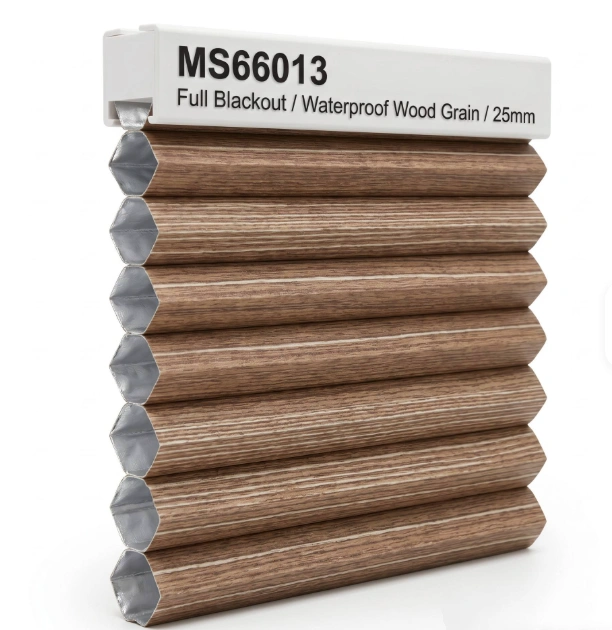
For buyers, designers & sourcing teams
CategoryUncategorized
Use this article as a technical reference. Contact us if you need fabric samples, specifications or project support.
Honeycomb cellular shades are famous for their integrated advantages of light control, thermal insulation, and noise reduction. However, one-size-fits-all selection is the biggest mistake most homeowners make. Different living scenarios have completely core functional demands: shift workers need absolute daytime blackout, home theaters pursue zero light interference and immersive darkness, street-side apartments focus on noise reduction, and extreme temperature rooms require strong thermal insulation performance.
The difference between 10/16/25mm single-cell and double-cell honeycomb fabrics directly determines the final use effect. A wrong choice will lead to failed daytime sleep, blurred movie viewing experience, persistent indoor noise, and obvious indoor temperature imbalance. This professional scenario-based guide will match the most suitable honeycomb fabric specifications and installation schemes for four typical high-demand living spaces, helping you maximize the performance of honeycomb curtains and solve targeted household pain points.
1. Shift-Work Bedroom: Zero-Daylight Interruption for Reversed Sleep Rhythm
Shift workers, night-shift nurses, programmers and freelancers usually sleep during the day. Ordinary curtains cannot block strong outdoor sunlight, resulting in shallow sleep, easy waking, and poor sleep quality. The core demand of shift-work bedrooms is 100% blackout, weak light-free environment, and soft visual effect, rather than basic shading.
Optimal Fabric Specification SelectionPriority: Double-cell full blackout honeycomb fabric / 20–25mm single-cell full blackout fabric
Double-cell structure with double-layer air cavity and thickened blackout coating completely blocks visible light and ultraviolet rays, achieving true zero-light leakage. Compared with small-aperture 10mm/12mm single-cell fabrics with limited shading thickness, large-aperture thickened fabrics avoid light transmission caused by long-term sunlight aging. The physical blackout layer without chemical coating will not fade or leak light after years of use, maintaining stable all-day blackout effect.
Matching Installation & Auxiliary Scheme
Outside mount installation with 4–5cm widened edge overlap is the first choice to eliminate frame gap light leakage. For users who prefer the neat built-in look of inside mount, it is necessary to match full-set light-seal side stripes and top sealing strips to block all structural gaps. Electric cordless configuration is recommended to avoid manual pulling noise during rest, realizing silent light switching.
Scenario Avoidance Tips
Never choose translucent or semi-blackout fabrics, small-aperture thin single-cell fabrics. Do not pursue ultra-thin stacking at the cost of shading performance. Slight daylight penetration will directly destroy the daytime deep sleep environment and affect the recovery of sleep quality for long-term shift workers.
2. Home Theater Room: Zero-Glare, Full Blackout & Stable Light Environment
The core demand of home theater spaces is immersive darkness, zero screen reflection, and stable indoor light environment. Even tiny edge light leakage and astigmatism will cause screen glare, reduce viewing contrast, and destroy the cinema-level viewing experience. Meanwhile, a certain noise reduction function is required to isolate outdoor environmental noise and improve sound field purity.
Optimal Fabric Specification SelectionPriority: Double-cell matte full blackout honeycomb fabric (16–20mm)
Matte non-reflective fabric surface is the key to avoid screen light reflection, different from glossy ordinary blackout fabrics that are prone to light reflection. The double-cell dual-air-layer structure achieves ultra-high shading rate up to 99.99%, completely shielding outdoor strong light and stray light. Moderate 16–20mm aperture balances structural thickness and flatness, ensuring the curtain fits closely without wrinkles after closing, preventing local light leakage caused by fabric unevenness.
In addition, the double-cell honeycomb structure has excellent sound absorption performance, which can weaken medium and high-frequency noise, reduce indoor sound echo, and further optimize the theater sound effect.
Professional Matching Skills
Full outside mount installation is adopted with no reserved gaps around to achieve seamless blackout. It is recommended to customize dark gray, dark coffee and other low-saturation dark fabrics, which have lower light reflection rate than pure white and light-colored fabrics, and better fit the dark viewing atmosphere. Electric linkage control can realize one-key full blackout and light opening, which is convenient for movie viewing scene switching.
Scenario Avoidance Tips
Avoid light-colored glossy blackout fabrics and small-aperture single-cell fabrics with insufficient thickness. Do not use inside mount without light-seal strips, as edge stray light will seriously reduce the viewing resolution and immersion of the home theater.
3. Street-Side Noisy Apartment: Strong Noise Reduction & Sound Insulation Optimization
Houses facing streets, viaducts and commercial streets suffer from long-term interference of traffic noise, pedestrian noise and outdoor noise pollution, resulting in noisy indoor environment and difficulty in quiet rest. The core demand of such scenarios is multi-dimensional noise reduction, while maintaining basic heat insulation and shading performance.
Optimal Fabric Specification SelectionPriority: Thickened double-cell honeycomb fabric / 25mm large-aperture single-cell high-density fabric
The noise reduction principle of honeycomb curtains lies in the hollow air cavity structure: the larger the cavity volume and the more the layers, the stronger the ability to absorb and weaken sound waves. Double-cell double-layer air cavity forms a secondary noise reduction barrier, which can effectively isolate low-frequency traffic noise and high-frequency environmental noise, with a noise reduction effect 40%–60% higher than ordinary single-layer curtains.
The 25mm large-aperture single-cell fabric has a larger static air storage space, which can fully buffer sound wave transmission and greatly reduce indoor noise decibels. High-density recycled polyester fabrics with tight weaving process avoid sound penetration caused by loose fabric texture.
Noise Reduction Reinforcement Scheme
Adopt full-coverage outside mount installation to seal window gaps. Window gaps are the main sound transmission channels. Completely covering window frames and wall gaps can block most of the air-conducted noise. Cooperate with light-seal side and top sealing strips to eliminate tiny gaps, realizing dual optimization of sound insulation and shading. For ultra-noisy core street scenes, double-cell full blackout thickened version is the ultimate choice.
Scenario Avoidance Tips
Do not choose thin 10mm/12mm small-aperture single-cell fabrics. Small cavities have limited sound absorption space and cannot improve the noisy indoor environment. Translucent thin fabrics have loose texture and almost no noise reduction effect, which is completely unable to adapt to street-side noisy households.
4. Cold-Winter & Hot-Summer Extreme Temperature Room: High Thermal Insulation & Constant Temperature Control
Top-floor units, sun room suites, and north-facing cold units have prominent seasonal temperature problems: extremely hot and stuffy with severe heat radiation in summer, cold air permeating through windows and serious heat loss in winter, resulting in high air-conditioning and heating energy consumption and poor indoor comfort. The core demand is strong heat insulation, heat preservation, and efficient energy saving.
Optimal Fabric Specification Selection
Priority: Double-cell honeycomb fabric (all-round recommendation) / 20–25mm large-aperture single-cell fabric
Honeycomb curtain is the window treatment with the highest R-value (thermal insulation value). The closed static air cavity can effectively block heat radiation and air convection. Double-cell superimposed air layer doubles the thermal insulation capacity, forming a stable constant-temperature barrier on the window surface.
In summer, it blocks outdoor solar heat and high-temperature air from pouring in, reducing indoor temperature by 3–5℃ and relieving air conditioning load; in winter, it locks indoor heating to prevent heat loss through window gaps, solving the problem of cold window surface and indoor heat dissipation. The 20–25mm large-aperture single-cell fabric has a larger air storage space, and the single-layer thermal insulation performance reaches the top level, which is sufficient for conventional extreme temperature households.
Temperature Control Optimization Scheme
For top-floor sun rooms with long-term strong light exposure, double-cell full blackout fabric is matched with outside mount full coverage installation to maximize heat insulation. For north-facing cold rooms in winter, large-aperture single-cell or double-cell warm-toned fabrics are selected to ensure heat preservation without affecting daily light transmission. All zero-harm auxiliary fabrics are preferred to avoid aging and heat insulation attenuation caused by chemical coating failure.
Scenario Avoidance Tips
Avoid small-aperture 10mm/12mm fabrics with thin air layers and weak thermal insulation. Do not choose low-quality chemically coated fabrics, which are prone to aging and peeling after long-term sun exposure, leading to rapid decline in thermal insulation performance and inability to adapt to long-term extreme temperature environments.
Quick Scenario Matching Cheat Sheet
1. Shift-work daytime sleeping bedroom: Double-cell full blackout / 20–25mm single-cell full blackout + full light-seal treatment
2. Home theater room: 16–20mm double-cell matte full blackout + outside mount seamless installation
3. Street-side noisy户型: 25mm large-aperture single-cell / double-cell thickened fabric + full gap sealing
4. Hot-summer & cold-winter room: Double-cell full-range thermal insulation / 20–25mm large-aperture single-cell energy-saving fabric
Final Conclusion
The core of honeycomb curtain selection is scenario-oriented functional matching. Different living environments have completely different priority demands: sleep scenarios focus on zero light leakage, theater scenarios focus on anti-glare and immersion, street noisy scenarios focus on sound absorption and noise reduction, and extreme temperature scenarios focus on air layer thermal insulation.
Reasonable matching of aperture size, single/double-cell structure and installation scheme can maximize the core advantages of honeycomb fabrics, solve various household pain points such as poor sleep, noisy environment and uncomfortable temperature, and create a quiet, constant-temperature and high-comfort living space for different families.
Need help choosing the right cellular shade fabric?
Send us your application, light-control requirement, pleat size and estimated quantity. We can recommend suitable fabrics and sample options.
Related Articles
Explore more practical guides, product knowledge and window covering insights.
DDZC MNP2024: Getting To Know 20mm Honeycomb Curtain Fab
[Fabric Only] Boutique Modern Luxury Recessed Usa Hotel Wi…
READ ARTICLE →
Mastery of the Window: The 2026 Strategy for Honeycomb B
Ultimate Option ODM OEM Custom Wind Proof Pleated Honeycom…
READ ARTICLE →
The Engineering of Elegance: A Deep Dive into Honeycomb
26mm Electric Built-In Plain Honeycomb Curtain Fabric Wate…
READ ARTICLE →