Honeycomb Shade Drive System Comparison: Cordless Spring, TDBU, Cord Pull, Manual Slide & Smart Motor | Load Matching & Large-Size Motor Selection Guide
Professional-Grade Manufacturers Pvc Pleated Honeycomb …
For buyers, designers & sourcing teams
CategoryUncategorized
Use this article as a technical reference. Contact us if you need fabric samples, specifications or project support.
Honeycomb cellular shades rely on their hollow structure to deliver superior insulation, noise reduction, and blackout performance, but the overall service experience and service life are ultimately determined by the drive system. Many users encounter common problems such as uneven lifting, sagging bottom rails, spring failure, motor jitter, and hardware deformation not because of poor fabric quality, but due to mismatched drive modes, unreasonable load bearing, and incorrect motor selection.
Different from ordinary flat curtains, honeycomb fabrics have distinct weight differences caused by aperture size (10mm to 25mm) and single/double-cell structure. Thicker double-cell full blackout fabrics are far heavier than thin single-cell translucent styles, placing completely different loads on internal springs, headrail hardware, and drive motors.
This blog systematically analyzes five mainstream honeycomb shade drive solutions on the market: cordless spring system, TDBU (Top-Down Bottom-Up) dual-control system, traditional cord pull, manual push-pull, and smart motorized drive. It further explains fabric weight-load matching rules and key motor selection standards for large-size windows, providing accurate technical reference for home decoration selection, engineering customization, and after-sales maintenance.
1. Full Comparison of 5 Mainstream Honeycomb Shade Drive Systems
Each drive system has unique advantages in operation logic, safety, applicability, appearance, and maintenance cost. There is no universal best solution—only the most matching one based on window size, fabric weight, usage scenario, and functional demand.
1.1 Cordless Spring Drive System (Most Popular Household Choice)
The cordless spring system embeds high-tension constant-force springs inside the headrail, completely eliminating exposed pull cords. Users can freely lift or lower the shade by pushing or pulling the bottom rail, with arbitrary stop positioning at any height. It is the mainstream standard configuration for modern minimalist home honeycomb shades.
Core Advantages
- High Safety: No hanging cords, completely avoiding the risk of children and pets being entangled, meeting international child-safe window treatment standards.
- Neat Aesthetics: Ultra-clean window surface without redundant accessories, highly compatible with light luxury, minimalist, and modern decoration styles.
- Smooth Operation: Constant-force spring balance design saves labor during pushing and pulling, with stable arbitrary positioning and no automatic sliding.
- Low Maintenance: Simple internal structure, fewer vulnerable parts, and low daily failure rate.
Limitations
The spring has a fixed load range, making it only suitable for medium and light-weight fabrics. Long-term use will cause spring fatigue and tension attenuation, leading to problems such as difficult lifting, automatic falling, and uneven left-right height deviation. It cannot support ultra-large-size shades and super-heavy double-cell thick fabrics.
Applicable Scenarios: Conventional small and medium-sized windows, 10–16mm single-cell fabrics, bedroom and living room daily use.
1.2 TDBU (Top-Down Bottom-Up) Dual-Way Drive System
TDBU is an upgraded functional drive system that breaks the traditional single lifting mode. It supports two-way adjustment: lifting the shade from the bottom up for full shading, and lowering the fabric from the top down to reserve upper daylighting while maintaining lower privacy. It is available in both corded and cordless spring versions.
Core Advantages
- Flexible Light Control: Realizes segmented light adjustment and privacy protection. Users can retain soft natural light indoors while avoiding outdoor peeping, solving the dilemma of “either full shading or full light transmission”.
- High Scenario Adaptability: Ideal for low-floor windows, street-facing windows, and bay windows that require both lighting and privacy.
- Dual Structural Stability: Independent upper and lower track positioning, with neat fabric folding and no random wrinkling.
Limitations
The internal structure is more complex than ordinary single-lift systems, with higher assembly precision requirements. The dual-track structure increases overall weight, requiring higher spring tension and hardware load-bearing. It has stricter restrictions on fabric weight and window width; ultra-wide shades are prone to unbalanced stress and jamming.
Applicable Scenarios: Low-floor residential windows, office privacy windows, bay windows, and spaces requiring flexible light adjustment.
1.3 Traditional Cord Pull Drive System
The cord pull system is the most classic manual drive solution, adopting rope transmission and pulley limit structure. It controls the lifting and positioning of honeycomb shades through manual pulling of the draw cord, with mature technology and low cost.
Core Advantages
- Strong Load-Bearing Capacity: Not limited by spring tension, it can adapt to thickened 20–25mm single-cell and conventional double-cell fabrics, supporting medium and large-size window openings.
- Stable Positioning: The pulley locking structure is durable, with no tension attenuation, and long-term use does not cause sliding or deviation.
- Cost-Effective: Simple structure, low manufacturing and maintenance costs, convenient replacement and repair of vulnerable parts.
Limitations
Exposed draw cords have potential safety hazards for children and pets. The cords are prone to tangling, fraying, and aging after long-term use, affecting operation smoothness. The overall appearance is slightly messy, reducing the minimalist decorative effect.
Applicable Scenarios: Commercial engineering windows, high-rise non-residential windows, large-size conventional household windows, and cost-effective decoration projects.
1.4 Manual Push-Pull Drive System
The manual push-pull system is a simplified lightweight drive solution, mostly used for ultra-thin small-aperture honeycomb fabrics. It adopts track sliding positioning, and users push and pull the fabric left and right or up and down to complete switching, with no spring or cord structure inside.
Core Advantages
- Ultra-Light Operation: No tension resistance, push-pull switching is labor-saving and smooth.
- Super Low Failure Rate: Minimal internal vulnerable parts, almost no daily maintenance required.
- Ultra-Thin Installation: Simple hardware structure, small headrail volume, suitable for narrow window frames.
Limitations
Extremely limited load-bearing capacity, only suitable for ultra-light 10–12mm single-cell translucent fabrics. It cannot bear thick blackout fabrics, and is prone to track deviation and fabric sagging after bearing heavy weight. The positioning accuracy is general, and it cannot achieve precise arbitrary stop.
Applicable Scenarios: Bathroom small windows, aisle windows, balcony auxiliary windows, and ultra-narrow window frame spaces with low functional requirements.
1.5 Smart Motorized Drive System
The motorized smart drive is a high-end upgraded solution, built with a tubular silent motor, supporting remote control, wall switch control, and smart home linkage (Alexa, Google Home, Tuya). It realizes one-key lifting, timing switching, and intelligent scene linkage, completely getting rid of manual operation.
Core Advantages
- Intelligent & Labor-Saving: Fully automatic operation, suitable for high windows, large windows, and hard-to-reach window positions.
- Strong Load Adaptability: High-power motors support heavy double-cell full blackout fabrics and ultra-large-size customized shades.
- High-End Experience: Silent operation, stable lifting, precise positioning, and intelligent scene linkage, matching high-end smart home decoration.
- Durable & Anti-Aging: No spring fatigue problem, long-term operation maintains stable performance.
Limitations
High overall cost, requiring power supply or lithium battery configuration. The installation and debugging difficulty is higher than manual systems, and professional installation is required. Battery-powered models need regular charging and maintenance.
Applicable Scenarios: Villa large floor-to-ceiling windows, sun room windows, high-rise high windows, smart home full-house customization, home theater scenes.
2. Fabric Weight Impact on Hardware & Spring Load Bearing
The core failure root cause of most manual honeycomb shade drive systems is mismatched fabric weight and load-bearing components. Different honeycomb structures and apertures lead to obvious weight differences, which directly determine the specification matching of internal springs, headrail thickness, and bottom rail hardware.
2.1 Weight Classification of Common Honeycomb Fabrics
Lightweight Grade: 10mm/12mm single-cell translucent/semi-shading fabrics. Light texture, low overall weight, small load pressure, suitable for spring cordless and manual push-pull systems.
Medium Weight Grade: 16mm single-cell full blackout fabrics. Balanced weight, the most versatile specification, compatible with high-quality spring cordless, TDBU, and ordinary cord pull systems.
Heavyweight Grade: 20mm/25mm large-aperture single-cell and conventional double-cell full blackout fabrics. Thickened fabric with increased layered structure, significantly increased overall weight, easy to cause spring overload and hardware deformation, not suitable for ordinary thin spring cordless systems.
Ultra-Heavy Grade: Thickened double-cell full blackout + wide-size customization. Super heavy overall load, must eliminate all manual spring systems, only suitable for cord pull high-load or professional motorized drive.
2.2 Spring Load Matching Rules
Ordinary standard springs are only applicable to lightweight and medium-weight fabrics within 16mm aperture. When matching heavyweight 20–25mm single-cell and double-cell fabrics, standard springs will be overloaded for a long time, resulting in accelerated fatigue, reduced tension, inability to lift, and automatic falling.
High-load reinforced constant-force springs must be used for heavy fabrics to ensure balanced upward tension. If the spring tension is insufficient, the bottom rail will sag and the fabric will fold unevenly; if the tension is excessive, the shade will automatically rise and fail to position stably.
2.3 Hardware Load-Bearing Adaptability
Light fabrics can be matched with conventional thin aluminum headrails and ordinary bottom rails. Heavy and ultra-heavy fabrics require thickened and reinforced headrails, widened weighted bottom rails, and enhanced fixed brackets. Thin hardware will deform and bend under long-term heavy load, causing the shade to tilt, lift jitter, and structural damage.
3. Key Motor Selection Points for Large-Size Honeycomb Shades
Large-size floor-to-ceiling windows and ultra-wide bay windows have oversized fabric area and total load. Ordinary low-power motors are prone to insufficient power, jitter, stalling, and even motor burnout. The following core standards must be followed for motor selection.
3.1 Power Matching Based on Fabric Load
Lightweight small-size single-cell fabrics (width ≤ 2m): Low-power silent lithium battery motors are sufficient, with energy saving and low noise.
Medium-large size 16–20mm fabrics (width 2–3.5m): Medium-power constant-speed motors are required to ensure stable lifting power reserve.
Ultra-large size double-cell heavy fabrics (width ≥ 3.5m): High-torque high-power tubular motors must be selected, with overload protection function to avoid stalling damage caused by excessive load.
3.2 Silent & Stable Operation Requirements
Large-area shades have large friction during operation, so motors must have built-in silent reduction gears and soft start-stop functions to avoid jitter and impact noise during lifting and closing, ensuring smooth and quiet operation.
3.3 Overload & Limit Protection Mechanism
Large-size heavy loads are prone to overload stalling. Qualified large-size motors must have automatic overload power-off and upper/lower limit memory functions, which can automatically cut off power when encountering resistance or reaching the limit position, protecting the motor and fabric structure from damage.
3.4 Power Supply Mode Selection
Small and medium-sized windows can choose lithium battery wireless motors with simple installation and no wiring. Ultra-large heavy-load shades must choose wired constant-power AC motors, which have more stable power output and no insufficient power attenuation caused by battery aging.
4. Drive System Quick Selection Cheat Sheet
1. Small window + 10/12mm lightweight fabric + family safety priority: Standard cordless spring system
2. Low-floor window + privacy & flexible light demand: TDBU top-down bottom-up dual-control system
3. Medium-large window + 16–20mm medium/heavy fabric + cost priority: Traditional cord pull system
4. Ultra-narrow small window + ultra-light fabric: Simplified manual push-pull system
5. Large floor-to-ceiling window + double-cell heavy fabric + smart home: High-torque silent motorized system
5. Conclusion
The selection of honeycomb shade drive systems must follow the core logic of fabric weight-load matching + scenario demand adaptation. Each drive mode has its own applicable boundaries: cordless spring focuses on safety and aesthetics for conventional households, TDBU solves flexible light adjustment and privacy pain points, cord pull balances cost and load-bearing, manual push-pull adapts ultra-light small windows, and smart motors are the optimal solution for large-size heavy-load and high-end smart scenes.
Reasonable matching of drive system, spring load, hardware specification and motor power can completely avoid common failures such as spring fatigue, hardware deformation, motor stalling and jitter, maximize the service life and operating experience of honeycomb curtains, and achieve the best balance of beauty, practicality and durability.
Need help choosing the right cellular shade fabric?
Send us your application, light-control requirement, pleat size and estimated quantity. We can recommend suitable fabrics and sample options.
Related Articles
Explore more practical guides, product knowledge and window covering insights.
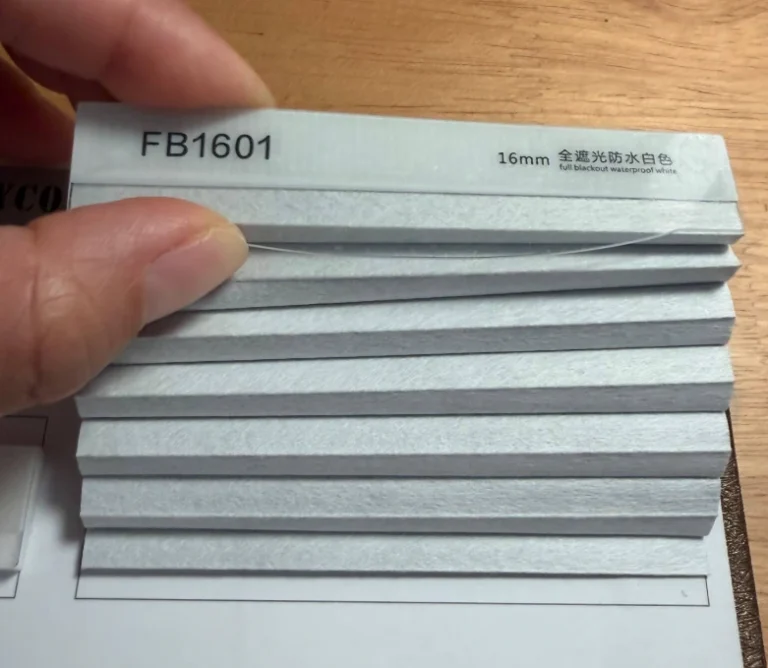
16mm Full Blackout Cellular Shade Fabric
ODM OEM Elite Making Raw Material Pleated Honeycomb Cellul…
READ ARTICLE →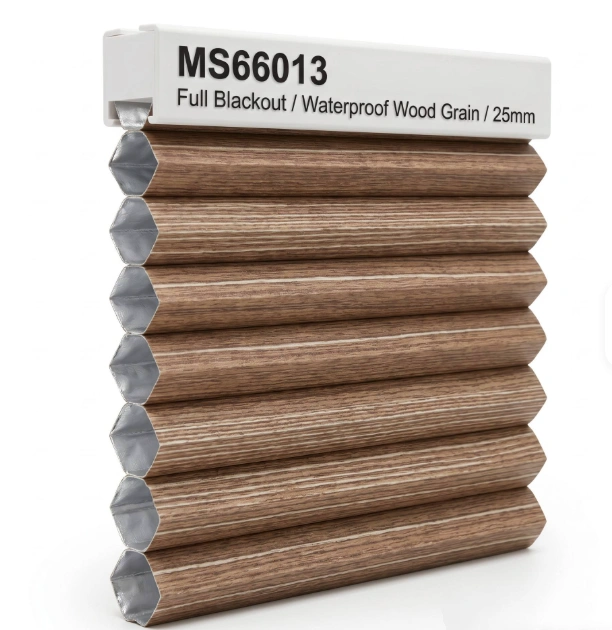
Best Honeycomb Curtain Selection by Living Scenarios: Sh
Custom 25mm Wood Grain Coffee Full Blackout Spunlace Non-w…
READ ARTICLE →
Sustainable Window Treatments: Recycled Polyester Honeyc
ODM OEM Custom Doors and Soundproofing Material Pleated Ho…
READ ARTICLE →